
Utility costs have increased significantly over the past several years. We wrote an article to explain the main drivers behind these recent increases. In general, though, bills increase when energy use increases, energy prices increase, or a combination of these things. Below we provide information on how to reduce energy use and energy costs. We also include some information that can help people with limited financial resources pay unexpected high bills.
3 Ways to Reduce Energy Bills
There are three things you can do to lower your bills: reduce the amount of energy you use, reduce the cost of the energy, and access discounts or subsidies on your bill, including through community subscription solar.
If you have noticed an increase in the amount you are paying for energy, you may first want to try to figure out what is behind the increase to address this more strategically.
Has your usage increased recently? Electricity use is measured in kilowatt hours (kwh), and natural gas (methane) is measured in therms. You can use the “Usage Chart” on your bill (an example is below) to compare your usage from month to month. If the usage is similar (or any changes make sense), then the main cause of your increased bills is likely the cost of your energy more than the amount you are using. We address energy costs in section 2 below. If your energy usage is much higher in certain months, do you know the reason for it? Weather, new appliances, switching heating sources, winter vs. summer? If you know what is behind the increased use, you can home in on strategies that may address that increase.
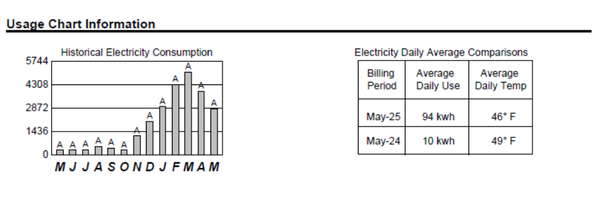
(The above bill shows electricity usage of someone who installed a heat pump in October 2024 after switching from natural gas, which is why their May ‘25 electric usage is higher than May ‘24.)
Other factors that may influence a significant increase in bills include:
Delayed billing (not receiving a bill one month, and having those charges reflected in the following month’s bill)
If using Budget Billing, possibility of larger end-of-year bill if budget not sufficient
Reduce the amount of energy you use:
Whether or not your energy use has increased recently, you can still explore ways to reduce your energy use at home.
If you would like to reduce heating costs for your home, consider weatherization options. You can explore energy efficiency programs on this page, where you can find links to apply for an energy audit. For assistance navigating these programs, you can contact a Community Energy Advisor.
You can also employ do-it-yourself strategies for conserving heat in your home, which are explained on this webpage.
If you heat with heat pumps, you may appreciate this Efficiency Maine video called “Heat Pump User Tips.” Note that in reference to tip 2, “minimize thermostat setbacks”, there is some newer research indicating slight temperature setbacks may be beneficial for savings. In general, avoiding drastic temperature changes is recommended. Minimizing use of resistance heat (which may show on your device as “auxiliary heat” or “emergency heat”) also saves energy.
2. Reduce the cost of each unit of energy
Check who supplies your electricity. Your bill has two main electricity charges: Supply and Delivery. You may be signed up for a supplier (also referred to as an ESCO) with a higher rate than NYSEG’s default supply rate. Learn more about ESCOs and compare rates at the “NYS Power to Choose” website. Be aware of ESCO terms if you are signed up for one. If you would like to switch from an ESCO to NYSEG’s default supply rate, call your ESCO to cancel the service, then call NYSEG to verify the pending drop. Be aware that there may be termination fees for ending your ESCO contract.
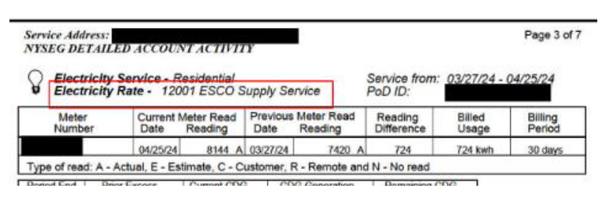
Example of a bill for a customer being supplied by an ESCO
Check your type of rate, also called your “residential electricity service option”. Look if you are getting a “Day/Night” rate or a “Standard” rate. You can compare the current supply rates for each service option at this link, and discuss your usage patterns with NYSEG to see which rate would be best for you.
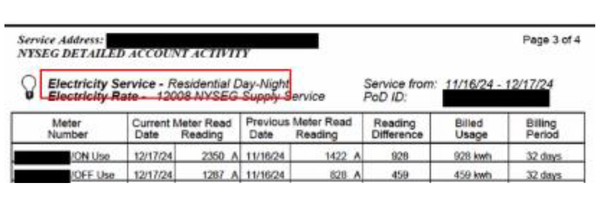
Example of a bill for a customer using the Day/Night rate.
Installing solar panels on your roof or property allows you to generate your own electricity, an investment that can significantly reduce or offset electricity costs in the long run. Learn more about NYS-certified contractors and available incentives at this link.
If you heat with propane, fuel oil, kerosene, or electric resistance heat (such as electric baseboards), savings are available by switching to air source or ground source heat pumps. Propane, oil and kerosene have consistently been more expensive than efficient heat pump heating systems. You can compare the costs of heating with different sources of fuel and systems at https://www.efficiencymaine.com/at-home/heating-cost-comparison/.
3. Access discounts on your bill
Low-income households may qualify for these energy assistance programs:
Home Energy Assistance Program (HEAP) provides a discount toward your heating costs. Contact your local HEAP office, often the Department of Social Services for your county, to learn more and apply. Offices for the Aging can also help seniors access HEAP.
NYSEG’s Energy Affordability Program (EAP), which appears on the bill as an “Energy Assistance Credit,” a discount on your bill. Those ineligible for the EAP may qualify for the Enhanced Energy Affordability Program (EEAP).
Additionally, all customers of major electric utilities can sign up for Community subscription solar, which allows you to sign up for solar credits that lower your utility bill, typically saving you 5 or 10% on your electric bill. If you receive HEAP, SNAP, or other low-income programs, you can ask the companies if they will provide you a 20% discount (especially Solar Simplified, Nexamp, or Citizen’s Energy). Subscription Solar credits appear as “CDG” (Community Distributed Generation) credits on your NYSEG bill. Learn more here.
If you have subscription solar and your electricity usage has recently changed due to installing heat pumps or otherwise, you can ask your Subscription Solar provider to allocate more capacity to your home.
For assistance paying your bill:
The above provided ways to reduce your bill by reducing energy use, finding or generating your own lower cost energy, or signing up for bill discounts. The following is a list of resources to help households that are struggling to pay their bills or have fallen behind on payments.
Call NYSEG Customer Service (800.572.1111) to discuss payment options for your bill (sometimes they can set up a plan where you can pay some now and catch up with the rest of the bill later, called a Deferred Payment Plan). You can also ask them about their Energy Affordability Program (EAP), which appears on the bill on the Energy Assistance Credit and is a discount on your bill. Those ineligible for the EAP may qualify for the Enhanced Energy Affordability Program (EEAP).
Call your county’s Department of Social Services to see if you are receiving their Home Energy Assistance Program (HEAP) credit toward your bill, or if they can offer you other assistance. Offices for the Aging can also help seniors access HEAP.
If you have a shut-off notice, potential sources of assistance include Catholic Charities, United Way, Project SHARE from NYSEG, and local charities and churches. Calling 211 is another way to explore local resources.
See more information about bill payment assistance on our No-Heat Assistance webpage.
New York State Social Care Networks (SCN) help eligible Medicaid members access free services for housing, food, transportation, and more through the Medicaid 1115 Waiver. This can include utility bill and/or rent assistance, if you are both unable to pay utility bills and at risk of eviction. Contact your local Social Care Network to learn more.
To address questions or suspected errors on your bill
Contact NYSEG Customer Service (800.572.1111)
If billed for an unexpected amount of energy, you can request a meter check from NYSEG
NYSEG Customer Advocates (for vulnerable populations)
If you believe you’ve been billed incorrectly and cannot resolve the issue with NYSEG, you can file a complaint with the DPS
PULP (Public Utility Law Project) hotline: 877-669-2572 or info@utilityproject.org
Options to act beyond your household
Comment on rate cases during public comment periods. Rate cases are the regulated process overseen by the state’s Public Service Commission through which utilities set their prices. The process is open to the public.
Explore energy-focused community organizations that align with your interests.
Share your thoughts and concerns with your local elected representatives.
Sign up for Smart Energy Choices newsletter to hear about public input opportunities, upcoming workshops, and more.
Hopefully this information helps address your concerns about your bill. If you would like to discuss your bill further, you can contact a Community Energy Advisor. You can also learn more by watching this recording of an “Understanding Your Utility Bill” webinar that our Community Energy Advisors hosted in March 2026.