
By Jes Wickham
This is an article comparing Energy Service Companies (ESCOs) and community subscription solar projects. Visit our main ESCOs page and community subscription solar page for more information on each option individually.
Many residents have received a piece of mail or have seen promotion for an Energy Service Company (ESCO) or Community Subscription Solar program in the past. You may have even seen some people going door to door trying to sign people up to one of these. Are they legitimate? What is the difference between them? In this article, we present an overview of ESCOs and Community Subscription Solar.
Understanding Your Utility Bill
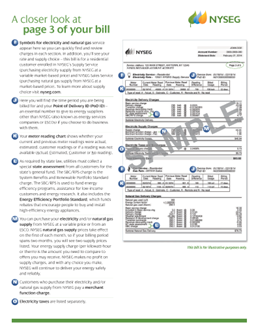
ESCOs and subscription solar affect your utility bill charges differently, so here’s a brief overview of what each charge means.
Utility bills typically have two main types of “charges” that contribute to your total cost (see example). “Supply charges” are what you pay for the energy you use. “Delivery charges” are what you pay your utility to deliver electricity and, where applicable, natural gas to your home. These charges cover the costs of facilities like transformers, distribution lines, gas pipes, and customer service billing.
Your utility bill also includes a basic service charge (a flat monthly fee regardless of how much or little energy you use), taxes and surcharges, depending on where you live.
Defining ESCOs and Subscription Solar
ESCOs supply electricity and/or natural gas, which your local utility delivers. An energy supplier is the company that purchases energy from energy producers, packages it, and sells it to the consumer. Suppliers decide where their energy is produced, which means they can offer different packages based on energy sources.
If you don’t choose an ESCO, your utility provides what's called “the default supply.” This default electricity is typically purchased on your behalf from a mix of generators available on the open market. If you do choose an ESCO, that supplier purchases electricity or natural gas directly from producers and can decide how and where it's generated — for example, from wind, solar, or fossil fuels.
Community Subscription Solar, on the other hand, provides bill credits from a large-scale solar array that offsets your electric bill. Subscription solar allows you to benefit from solar generation without owning the panels. Subscription solar works for those who receive a bill from a major utility (e.g., NYSEG) and do not have solar panels installed.
Community subscription solar offers savings on your total electrical bill regardless of whether you have a third-party supplier like an ESCO. Residents who do not own solar panels can have both an ESCO agreement and a solar subscription at the same time.
Differences
Energy Sources
Community subscription solar provides credits to offset your electric bill. ESCOs, on the other hand, replace your utility as the supplier. Community solar guarantees that the energy comes from renewable sources, whereas ESCOs may source energy from a mix of renewable and non-renewable sources. With both ESCOs and community solar, your utility will continue to deliver your energy.
Costs and Cost Savings
The costs and cost savings provided by an ESCO or subscription solar plan varies. A solar subscription can be up to a 5-20% discount on the usage charges on your electric bill annually. While the price of your electricity might fluctuate, you’re guaranteed savings on your utility’s electricity rates.
On the other hand, ESCOs do not guarantee savings. The DPS Power to Choose website includes a disclaimer outlining several precautions on ESCOs due to their pricing practices. It stresses that “the posted rates are guaranteed only for the specified period. The rate of a variable product is generally available for the first month, after which an ESCO could potentially increase the rate significantly.”
There is no cancellation fee or cost to leaving a subscription solar program. ESCOs, however, can be more restrictive, some requiring fees for early termination.
Bill Breakdown with ESCOs and Subscription Solar
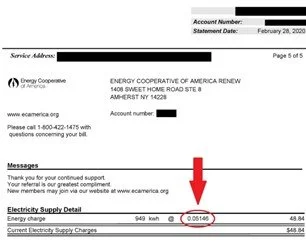
If you choose an ESCO, your utility will likely bill you on behalf of the ESCO and include the ESCO's charges on a later page of your utility bill. Alternatively, you may receive two bills: one bill from the ESCO for electricity and/or natural gas supply and other products it sells to you, and one from the utility for delivery charges. ESCOs can be from in state or out of state, and prices may reflect added-value services, like energy audits, energy management services, energy efficiency programs, and more. If you have an ESCO, the specific information about your energy supplier will be shown toward the end of your bill (see pictured example).
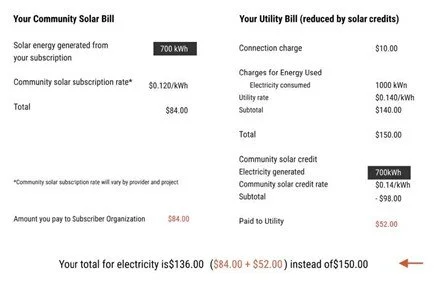
Solar credits are a deduction to your utility bill, so they are billed differently than ESCOs. Solar credits are typically handled in one of two ways: in consolidated billing or a two-bill system. Consolidated billing means your solar credits and utility charges appear on your regular monthly electricity bill (see below example).
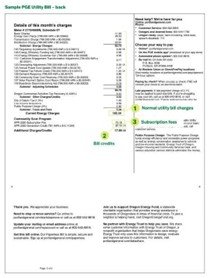
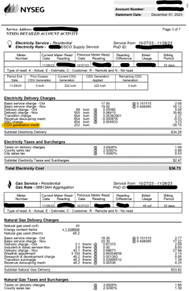
A two-bill system involves your usual utility bill and then a separate bill from the community solar provider. The utility bill would reflect your total electricity usage minus the credits (savings) generated by your solar subscription (see below example). The credits reduce your overall utility bill. The subscription solar bill would be sent 1-2 months after your credits have discounted your utility bill by the solar project manager, charging you for the solar credits at a discounted rate compared to standard electricity prices. The type of billing system doesn’t affect the cost savings of the subscription program.
Signing Up
If you’re interested in ESCOs and/or subscription solar, there are a few steps we as a Clean Energy Hub recommend.
First, do some research into available ESCOs and subscription solar plans as well as door-to-door sellers of either. Door-to-door salespeople may not have the full information on the product they are selling, and you may want to take more time to research before you make a decision.
You can research ESCO options by visiting the DPS Power to Choose website. Due to the previously mentioned pricing concerns, DPS encourages residents to check out the historical pricing of each ESCO they’re considering. While it won’t guarantee you’ll see the same trends in the future, it’ll at least give you an idea of how variable the energy prices have been. You can also review DPS’s Complaint Statistics Report to see if there have been any complaints against the ESCO you’re considering.
You can research subscription solar projects by visiting this interactive community solar map from the New York State Energy Research and Development Authority (NYSERDA). You can also check DPS’s list of registered community solar providers to verify a project’s legitimacy. You may want to consider finding reviews of solar providers or asking others in your community about their experience with subscription solar companies.
Before signing up for either an ESCO or subscription solar, be sure to fully review the terms and conditions, including contract length, special fees, deposits and more.
Your local Community Energy Advisor (CEA) can help you navigate these options. Find your local CEA by visiting our Contact Us page.